
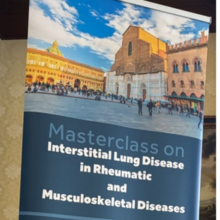
Reflections from the ILD Masterclass in Bologna, Italy
By Karen Cheng
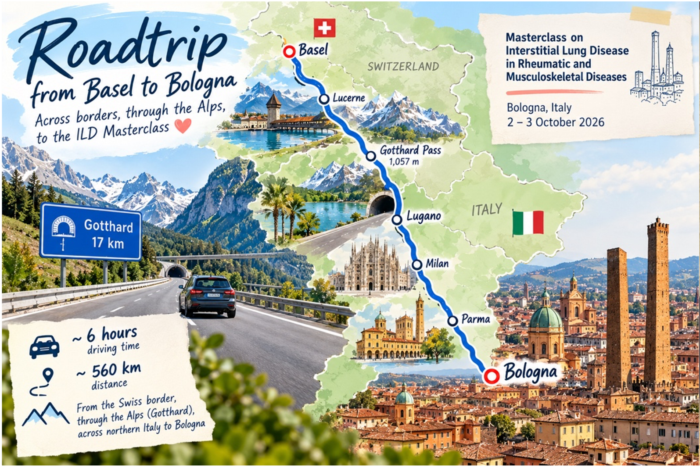
In early October 2026, I drove from my home in Basel, Switzerland to Bologna, Italy to attend the Masterclass on Interstitial Lung Disease (ILD) in Rheumatic and Musculoskeletal Diseases. As a myositis patient advocate, I was keen to deepen my understanding of ILD—not only in myositis but also across related autoimmune diseases, including systemic sclerosis (SSc), Sjögren’s disease (SjD), rheumatoid arthritis (RA), and vasculitis.
ILD is a serious complication of many rheumatic diseases, making early detection, monitoring, and appropriate treatment essential to improving patient outcomes. This two-day masterclass offered valuable insights from international experts on clinical assessment, high-resolution computer tomography (HRCT) imaging, lung function, biomarkers, and emerging treatment approaches.
A closer look at myositis-associated ILD
The session on myositis-related ILD provided valuable insights into this important complication, reported in about 40% of patients with myositis.1 Rheumatologists Dr. Antonella Notarnicola (Stockholm, Sweden) discussed screening and monitoring in IIM, Dr. Ana Maria Gheorghiu (Bucharest, Romania) reviewed treatment advances, and Dr. Maria Rosa Pellico (Milan, Italy) led a case-based discussion on the challenges of managing myositis with lung involvement.
These topics reinforced that myositis affects more than muscles; lung involvement can significantly impact prognosis, quality of life, and treatment. Early recognition of symptoms—including breathlessness, persistent cough, chest discomfort, reduced exercise tolerance, fatigue, and low oxygen levels—is essential. Regular pulmonary assessment, monitoring, and multidisciplinary communication should be integral to comprehensive myositis care.
As a patient with anti-SRP positive immune-mediated necrotizing myopathy (IMNM), as well as anti-TRIM21 (Ro52) and anti-U1RNP antibodies, I face a reported 20–45% risk of ILD.2,3 Although I have been free of this complication for more than 20 years with myositis, I remain vigilant and monitor my lung function regularly. Myositis-specific and -associated autoantibodies help stratify ILD risk, identify disease patterns, and predict progression. Antisynthetase syndrome-associated ILD (including anti-Jo-1, PL-7, and PL-12 autoantibodies) often responds to immunosuppressive treatment, although recurrence is common, particularly during glucocorticoid tapering or after treatment withdrawal.4,5 Anti-MDA5 dermatomyositis is associated with rapidly progressive ILD (RP-ILD) in approximately 50% of patients with high mortality risk.6 Anti-TRIM21 (Ro52) is also recognized as a “cross-disease amplifier” associated with RP-ILD.7
Learning across autoimmune diseases highlighted shared challenges in identifying at-risk patients, interpreting investigations, predicting progression, and guiding treatment. Overlap myositis may affect up to 50% of patients, often alongside conditions such as SjD, SSc, or RA.8 Differences between European and US treatment recommendations, including when to initiate therapy and which treatments to use, were discussed alongside the ERS/EULAR and ACR/CHEST guidelines for connective tissue disease-associated ILD.9,10
CAR-T therapy: Breakthrough or overpromise?
A lively debate between rheumatologists Prof. Oliver Distler (Zurich, Switzerland) and Prof. Anna-Maria Hoffmann-Vold (Oslo, Norway) explored the promise of CAR-T therapy in autoimmune diseases. The potential for deep, sustained—and possibly treatment-free—remission is exciting, but questions remain about long-term safety, durability, patient selection, accessibility, and clinical evidence. Audience votes shifted slightly towards “overpromise,” highlighting the need for ongoing trial data to determine CAR-T’s future role in practice. Personally, I voted “breakthrough”—and stand by it!
The value of patient perspectives and connections
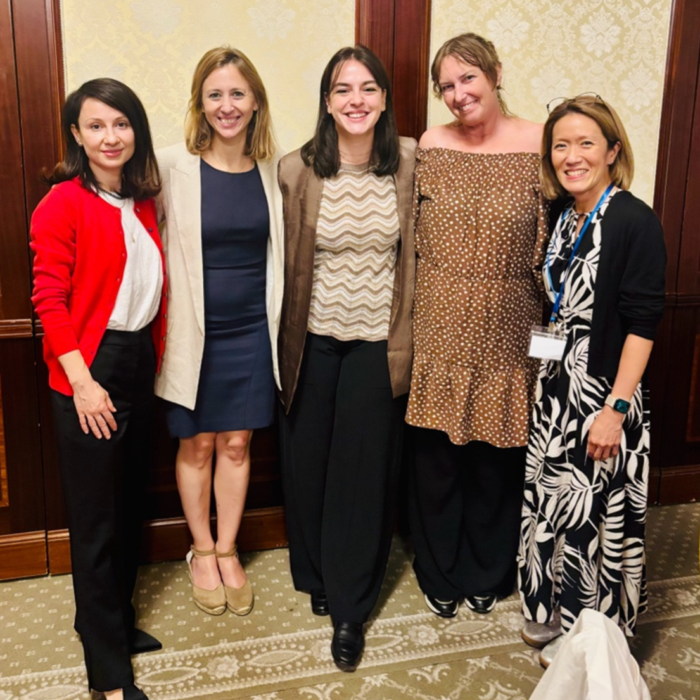
Attending this meeting alongside two fellow myositis and scleroderma patient advocates from Belgium brought valuable patient perspectives to the scientific discussions. Networking breaks and an informal dinner provided opportunities to exchange experiences, build connections, and discuss patient priorities and future research. I left Bologna with new knowledge, fresh perspectives, and meaningful connections, reminded that advancing care depends on collaboration across disciplines and with patients as active partners in shaping research and the future of care.
Karen Cheng, BChD, MFDSRCSEng, EMBA, is a leader in the international myositis patient advocacy community with a background in healthcare and executive leadership and a passion for advancing patient-centered myositis research through global partnerships.
Learn more:
- Hallowell & Danoff, 2023. Chest.
- Ge et al., 2022. BMC Pulm Med.
- Ma & Bu, 2022. Front Immunol.
- Patel et al., 2024. Int J Mol Sci.
- Kouranloo et al., 2025. Rheumatology (Oxford).
- Yang et al., 2025. Front Immunol.
- Yuan et al., 2025. Front Immunol.
- Fredi et al., 2018. Curr Opin Rheumatol.
- Johnson et al., 2024. Arthritis Care Res (Hoboken).
- Antoniou et al., 2026. Ann Rheum Dis.


