 MyoCon! September 24–27, 2026.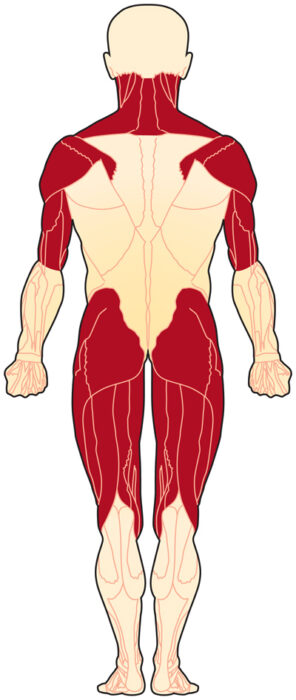
Immune-mediated necrotizing myopathy (IMNM)—also referred to as necrotizing autoimmune myopathy (NAM) or necrotizing myopathy (NM)—is an inflammatory muscle disease that involves necrosis, or cell death, in the muscles, which causes symmetrical (on both sides of the body) muscle weakness.
Immune-mediated necrotizing myopathy primarily affects proximal muscles, that is, the muscles closest to the center of the body. Onset is relatively quickly, happening over days, weeks, or months, and usually occurs in adults between the ages of 40 and 60.
As with other types of myositis, there is no known cause or cure for necrotizing myopathy. However, treatments are available that can successfully manage symptoms.
Signs and symptoms
Those with IMNM may experience the following symptoms:
- Weakness in the muscles closest to the center of the body, like the shoulders, forearms, hips, thighs, neck, and back
- Difficulty climbing stairs and standing up from a chair
- Difficulty lifting arms over the head
- Falling and difficulty getting up from a fall
- Shortness of breath and/or chronic dry cough
- Difficulty swallowing (dysphagia)
Disassociated from polymyositis
Immune-mediated necrotizing myopathy is a distinct subset of idiopathic inflammatory myopathy, or myositis. Those with IMNM have muscle biopsies characterized by predominant necrosis (i.e., death) of muscle cells with often less inflammation than other myositis subsets.
Before IMNM was recognized as a separate entity, many patients with this condition were labelled as polymyositis, because both subsets share similar clinical features. However, specific autoantibodies (for example, anti-HMGCR and SRP) and muscle biopsy features can help physicians differentiate those diseases.
Different forms of IMNM
There are different forms of necrotizing myopathies characterized by distinct risk factors and disease course. These categories are mainly differentiated based on autoantibodies measured in the patient’s blood.
IMNM with anti-SRP autoantibodies
Anti-signal recognition particle (SRP) autoantibodies are found in some patients with IMNM. Their presence are often associated with severe muscle weakness and difficulty swallowing. Inflammation of the lungs and heart can also be seen in that subset.
IMNM with anti-HMGCR autoantibodies
HMGCR (3-hydroxy-3-methylglutaryl-coenzyme A reductase) is a key enzyme in the production of cholesterol. Some patients exposed to HMGCR inhibitors for cholesterol treatment (that is, statins) or through dietary sources (for example, red yeast rice and oyster mushrooms) can develop anti-HMGCR autoantibodies. Sometimes, however, no environmental triggers are found to explain their presence. Anti-HMGCR positive IMNM usually presents with mainly severe muscle symptoms.
IMNM with no autoantibodies
Those with IMNM without anti-SRP or -HMGCR autoantibodies in their blood are considered by some experts to be included in a separate, third grouping of IMNM called seronegative.
If you are experiencing muscle symptoms involving weakness or fatigue, we encourage you to talk to your doctor to begin the diagnosis process, which usually includes a muscle biopsy to detect necrosis and various blood tests to detect the presence of autoantibodies. Since IMNM is a rare disease, many physicians may not be familiar with the signs and symptoms. If you are struggling to find an accurate diagnosis, visiting a specialist can help.
Revised April 2025 by Valérie Leclair, MD, PhD – rheumatologist, research scientist, and TMA medical advisor
See: Pinal-Fernandez I, Casal Dominguez M, Mammen A. Immune-Mediated Necrotizing Myopathy. Current Rheumatology Reports, 2018. 20(4). DOI:10.1007/s11926-018-0732-6
Disclaimer: Information provided on this website is for educational purposes only and is not a substitute for professional medical advice, diagnosis, or treatment. Always consult a qualified healthcare provider with any questions you may have regarding a medical condition.